
Licenses
Researchers should clearly define the legal conditions under which visual research data may be accessed and reused. When researchers retain copyright over their materials, licensing provides the mechanism to communicate whether and how others may reuse them.
Standardized licensing frameworks are commonly used because they provide clear and internationally recognized usage conditions. Some licenses allow reuse for any purpose, while others introduce restrictions, such as requiring attribution, limiting reuse to non-commercial purposes, or prohibiting the distribution of modified versions. These licensing choices directly influence the level of openness with which visual data can be shared.
Creative Commons as a Standard Licensing Framework
Among the most widely used options are Creative Commons licenses. They allow researchers to indicate, in a clear and interoperable way, what others are permitted to do with the material without requiring individual permissions. However, these licenses apply only to copyright and do not override data protection regulations. If visual materials contain personal or sensitive information, researchers must ensure that informed consent, anonymization, or appropriate access restrictions are in place before sharing the data.
Types of Creative Commons Licenses and Conditions of Reuse
Several types of Creative Commons licenses exist, each combining different conditions of reuse:
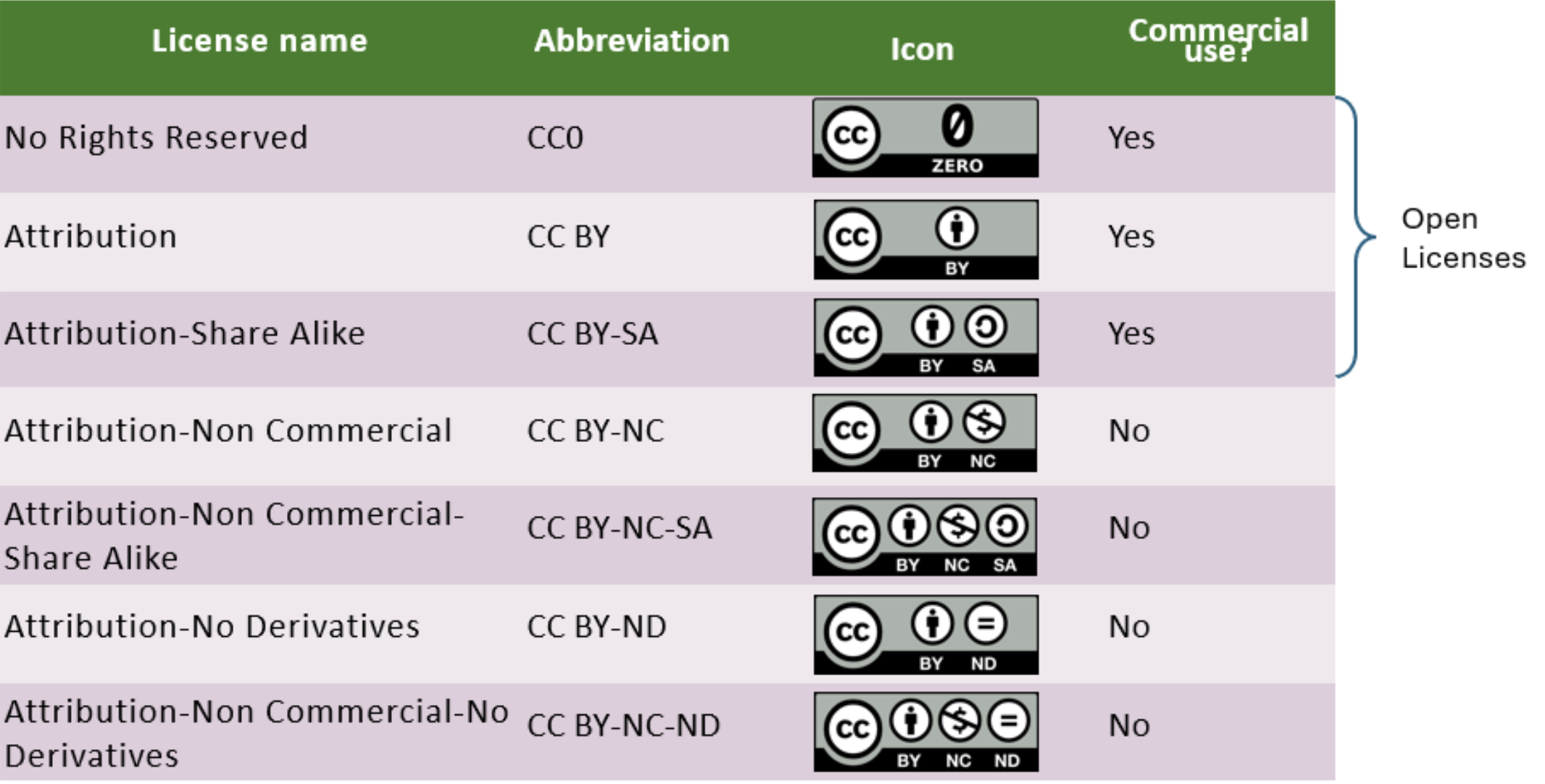
- CC0 (Public Domain Dedication): This option places the work as close as possible to the public domain. Anyone may copy, modify, distribute, and reuse the material without restrictions and without the legal requirement to attribute the author. In research contexts, however, good scholarly practice still encourages acknowledging the creator and the source.
- CC BY (Attribution): This license allows anyone to share, reuse, and modify the material for any purpose, including commercial uses, provided that the original author, source, and license are properly credited. It is one of the most commonly used licenses for open research data.
- CC BY-SA (Attribution–Share Alike): This license allows reuse and modification for any purpose, but requires that any derivative works be distributed under the same license. This ensures that future versions of the material remain equally open.
Some Creative Commons licenses introduce additional restrictions:
- NC (Non commercial): Materials may be reused and modified, but only for non-commercial purposes. Any use involving economic gain or commercial activity is not permitted without additional permission.
- ND (No Derivatives): Materials may be shared and redistributed, but they must remain unchanged. Modified versions or derivative works cannot be distributed.
These elements can be combined, resulting in licenses such as CC BY-NC, CC BY-ND, or CC BY-NC-ND, each defining different levels of openness and reuse possibilities.
Creative Commons licenses can typically be applied when visual materials are openly accessible. When visual data cannot be shared openly, because of privacy concerns, ethical constraints, or contextual sensitivity, repositories may instead provide controlled access. In such cases, tailored or project-specific licenses can specify who is allowed to access the materials, under which conditions they may be used, and whether modification or redistribution is permitted.