
Degrees of Openness
Determining appropriate degrees of openness ensures that visual research data are shared responsibly while balancing the objectives of open science with ethical and legal obligations. As a guiding principle, visual data should be made “as open as possible, as restricted as necessary.”
While open access supports transparency, verifiability, and reuse, researchers must also safeguard the rights and well-being of research participants, respect intellectual property, and address contextual sensitivities. Not all visual materials can or should be treated in the same way. Some visuals (e.g., images of public spaces or non-identifiable environments) may be suitable for open access, whereas visuals depicting identifiable individuals, private contexts, or sensitive situations may require restricted access, mediated access upon request, or may not be shared at all. In such cases, providing descriptive metadata or documentation remains recommended so that other researchers are aware of the dataset’s existence and potential relevance, in line with the principles of FAIR data stewardship.
Operationalizing and Documenting Degrees of Openness
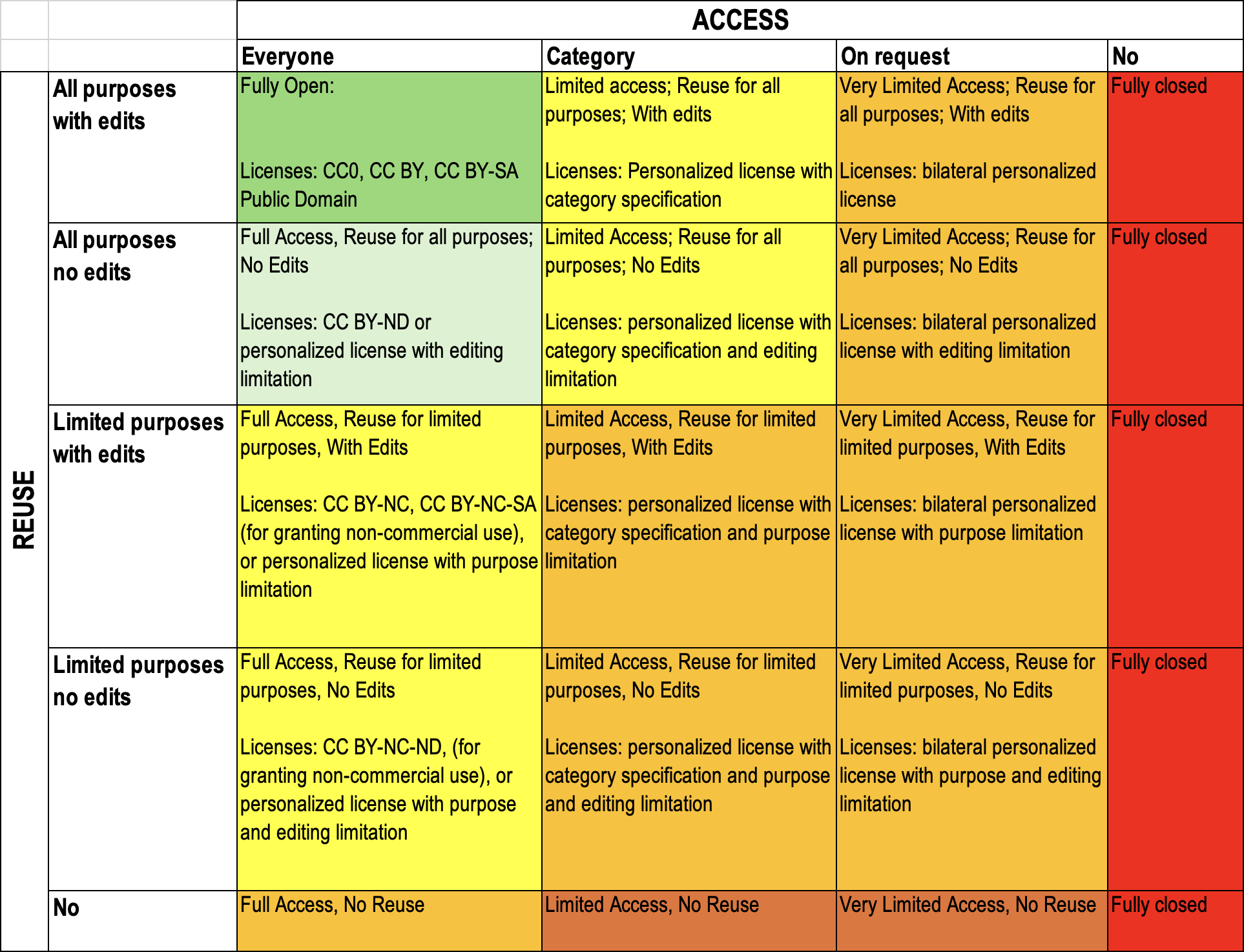
Operationalizing degrees of openness during archiving typically involves defining two complementary dimensions: permitted access and permitted usage. Permitted access determines who can view the visual materials, ranging from full open access to everyone, to access restricted to specific user groups (e.g., institutional researchers), to access granted only upon request, or complete non-access. Permitted usage determines what authorized users are allowed to do with the visuals, including whether reuse is allowed for any purpose or limited to specific purposes (e.g., research-only use), and whether modifications or derivative works are permitted. These conditions may be specified through standardized or tailored licensing agreements and should be clearly documented at the time of repository deposit.
Below we report a table we developed to show the different degrees of openness, based on different levels of permitted access and permitted usage.
Finally, the chosen degree of openness should be explicitly documented for each dataset – or, where possible, for individual visual items – together with relevant contextual information, consent conditions, and any restrictions on reuse. Such documentation ensures that future users understand the ethical, legal, and methodological boundaries associated with preserved materials, thereby supporting responsible reuse and long-term stewardship of visual research data.