
Alternative Description
In some cases, visual materials cannot be shared or archived openly because of privacy, ethical, or copyright constraints. Researchers may therefore consider replacing images with textual descriptions. This approach can help reduce the circulation of identifiable or sensitive personal data while still allowing some analytical content to remain accessible.
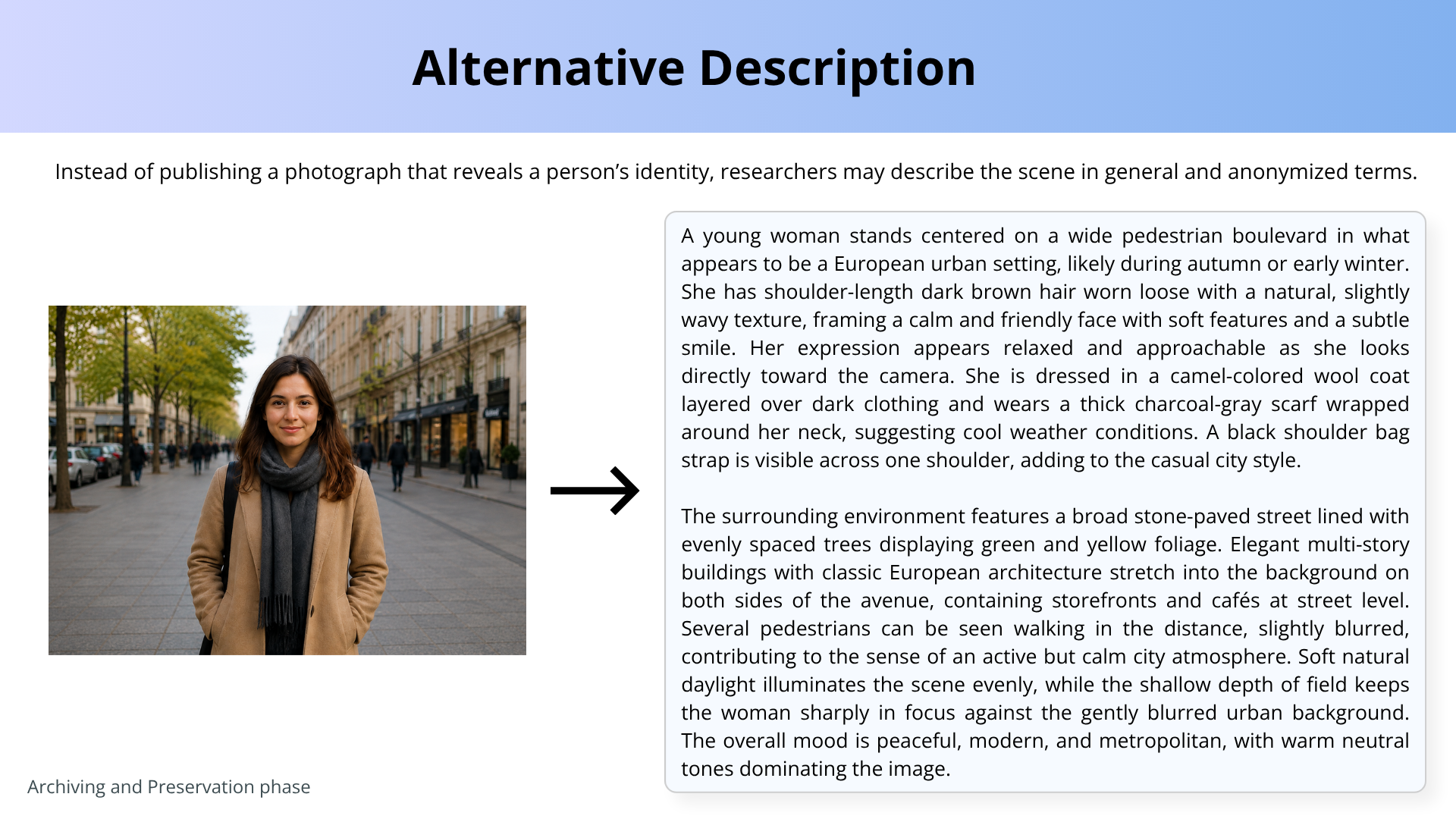
However, textual descriptions are not neutral substitutes for visual data. Every verbal description of visuals is a form of translation. Short descriptions often lack analytical depth, while detailed ones may still omit important visual elements such as color, spatial relations, gestures, or emotional tone. Because language always involves selection and interpretation, descriptions inevitably reduce and transform the meaning of the original visual material. It is thus important to focus on the elements that are relevant for analysis and acknowledge that a complete description that grasps all visual cues of an image is never possible. Describing images is also time-consuming and becomes difficult when datasets are large.
For this reason, textual descriptions should be understood as a partial solution rather than a full replacement for visual data. They may serve as an intermediate strategy between full openness and complete restriction, allowing some level of documentation or understanding when the original visuals cannot be shared. Researchers should also obtain permission to publish such descriptions during the consent process, since textual representations may still reveal sensitive information or function as indirect proxies for the original image. In addition, describing copyrighted visuals does not automatically bypass copyright restrictions, and permission from rights holders may still be required.